OVS Hub for terminals
Control across every vessel call


A shared operational layer aligned with your customers’ vessel movements
OVS Hub gives terminals a single, continuously updated view of each vessel call, based on live ETA and ETD schedules shared directly by carriers and feeders. Covering more than 90% of DCSA member carrier schedules, it aligns terminal planning with customer vessel movements earlier, before changes cascade into berth rework, yard congestion, or last-minute crane reallocations.
One timeline for every port call
OVS Hub connects your existing systems and teams through a single integration, linking you to all participating carriers. Schedule events and updates are shared continuously, so everyone works from the same standardized timeline, available via API or the OVS Hub platform. OVS Hub aligns port-call changes upstream, limiting late coordination and downstream operational rework at terminals.

Real time vessel schedule changes shared continuously.

Early load and discharge data enable advance berth planning

Decisions improve before disruption turns into cost.
OVS Hub acts as a coordination layer between terminals and vessel operators, improving planning stability across berth, yard and labour without changing how terminals run their systems.
How it works
OVS Hub is built on DCSA standards, including the Operational Vessel Schedules 3.0 API, ensuring consistent structure, shared definitions, and easier integration with existing carrier and terminal systems.
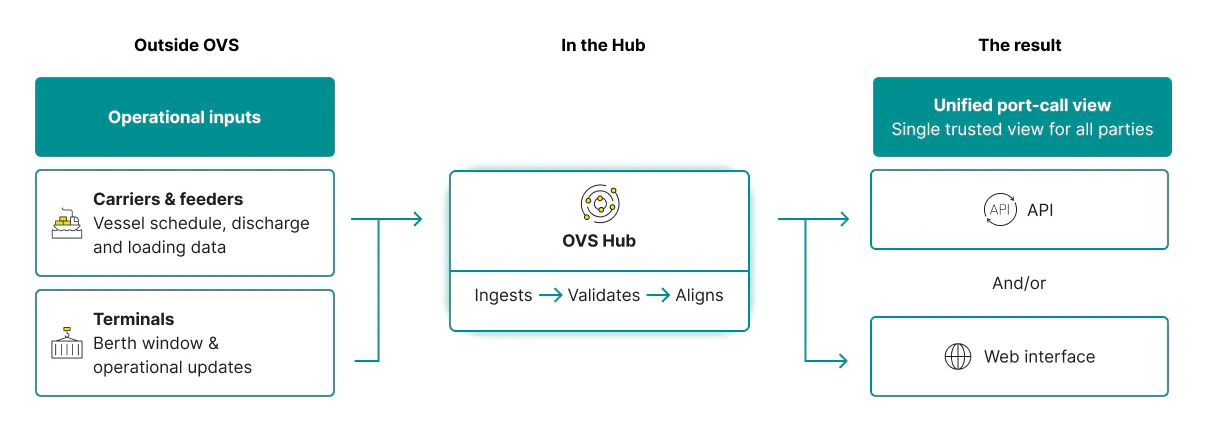
Built to fit seamlessly into your existing workflows
OVS Hub connects operational data from multiple sources into a single operational reference. Schedule and timing changes, including load and discharge signals, update across the network in real time.

Integrate once, reach all partners on the platform

Replace bilateral interfaces with a single connection

Use the web interface where integration is not required
Join the Hub
Joining OVS Hub means planning berth, yard and labour decisions against earlier, shared port-call signals rather than late, bilateral updates. It reduces berth rework, limits downstream disruption, and removes the need to reconcile conflicting inputs across counterparties.
Talk to us about joining OVS Hub
Talk to us about joining OVS Hub
A product from DCSA
OVS Hub is a product of the Digital Container Shipping Association (DCSA). It is vendor‑neutral, industry‑backed and designed to support collaboration. Data sharing is governed through clear access controls, limited to relevant operational partners, and aligned with DCSA standards and principles.
A product from DCSA
OVS Hub is a product of the Digital Container Shipping Association (DCSA). It is vendor‑neutral, industry‑backed and designed to support collaboration. Data sharing is governed through clear access controls, limited to relevant operational partners, and aligned with DCSA standards and principles.