by Iker Echave, Head of Standards at DCSATwo companies can both say they have adopted the same digital standard. They may use the same API name, the same version number and the same technical specification. Yet when their systems exchange data, things can still fail to line up.Take a real example from the booking process: the expected departure date. In an end-to-end shipment, this could refer to departure from the customer’s place of receipt or to the vessel’s departure from the port of loading. If two systems interpret the field differently, the message may be technically valid while the parties are working with two different milestones. For the customer, that can mean incorrect expectations, additional checks, booking amendments and more manual follow-up.This distinction is now explicitly addressed in the DCSA Booking Standard. But it illustrates a broader challenge: publishing a standard is not enough. It must also be implemented consistently.That is what interoperability means in practical terms. A customer, freight forwarder or solution provider should be able to build one connection based on a DCSA standard and use it across multiple conformant carriers, without redesigning the integration each time. The systems understand the information in the same way, allowing it to move between them reliably and with much less manual intervention.Ultimately, DCSA’s mission is not to publish standards. Standards are the means, not the end. Our mission is to create interoperability, so customers can enjoy a seamless digital experience irrespective of the carrier they choose to work with.
A standard only creates value when systems work together
Container shipping depends on a dense network of carriers, terminals, ports, cargo owners, freight forwarders and solution providers. Every participant is under pressure to digitalize, often implementing the same published standards independently and in parallel.A standard defines a common way of exchanging information. But its value ultimately depends on how consistently it is implemented. Without a way to verify this, small differences in interpretation can go unnoticed. Integrations are then built around carrier-specific assumptions, problems emerge late and customers are left dealing with manual checks, workarounds and costly rework.This is not a failure of intent. Every organization implementing a DCSA standard is trying to get it right. The problem is visibility. Without a common way to test implementations, good-faith adoption and genuine interoperability can drift apart.For DCSA, reducing this friction is fundamental. Our value is not simply in publishing technical specifications. It is in making it easier for customers and other industry participants to connect, exchange information and manage shipments across multiple partners. When standards are implemented consistently, customers spend less time correcting data and adapting to different systems, and more processes can happen automatically.Conformance turns assumptions into proof
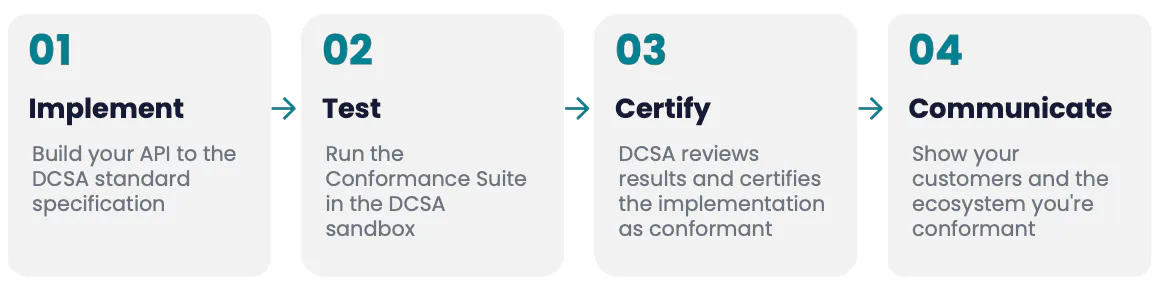
Conformance closes the gap between adopting a standard and demonstrating that it works as intended.It is a structured process that tests a real implementation against a shared set of business and technical scenarios. The same requirements are applied every time, so that “conformant” has a clear and consistent meaning, regardless of which organization is making the claim.The process is straightforward:- Implement the API according to the DCSA standard.
- Test it against shared scenarios using DCSA’s conformance framework.
- Confirm that the implementation behaves as the standard requires.
- Communicate the result so customers and partners can see what has been verified.
The outcome carries a precise meaning: it identifies the standard and version, the role played by the organization and the scope that has been tested. It replaces a general claim of adoption with specific, checkable evidence.Most importantly, it gives customers confidence that an integration built against the standard can work with other conformant implementations. In simple terms: connect once, then connect with many.